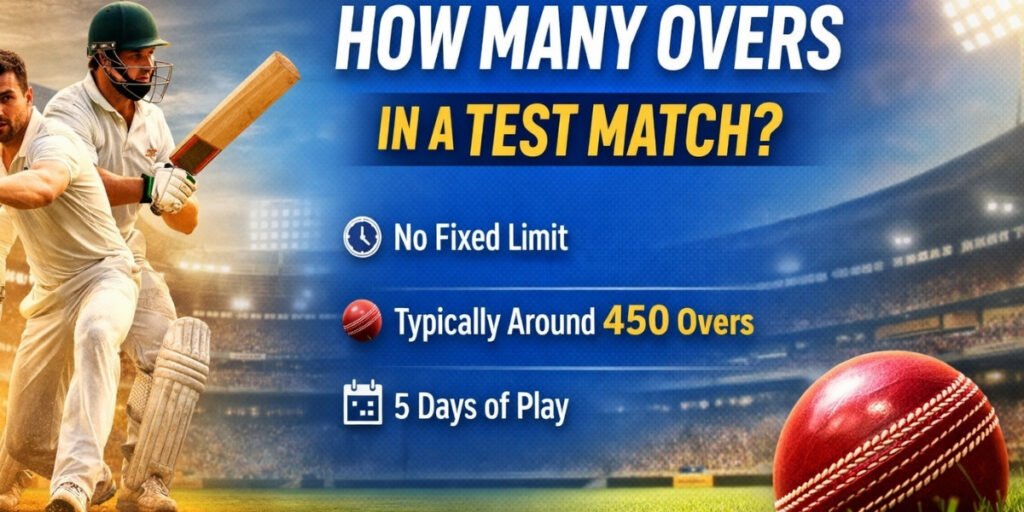

They can be regarded as the longest and oldest format of the game. It’s played over several days and is all about patience, strategy, and endurance. A question often posed by new fans is how many overs are actually played in a Test match.
There is no constant answer, and this is precisely what sets Test cricket apart from the other formats. In this article, you will know what overs mean in Test match cricket. Let’s have a look.
Does Test cricket have a limited number of overs?
A Test match does not have a set number of overs. While ODIs and T20s are played with a fixed number of overs for each team, Test matches are time-bound.
A Test match lasts for five days, and there is no limit on the number of overs a team can face. Instead, they keep batting until they either lose all their wickets or declare their innings. And this flexible format is precisely what makes Test cricket unique and strategic.
Test Match Average Overs (Per Day)
There is no hard and fast rule, but traditionally, a Test match has close to 450 overs in total. That is based on the requirement of how many overs would be bowled in a day, averaged over five days.
The number of overs one would expect daily, and summing them gives a rough total. But this is a guideline and not a definitive guideline.
How Many Overs Are in a Day?
Day one of the Test has a target of 90 overs to be bowled. It is a common rule observed in international games to promote appropriate play and equality.
Test cricket has three sessions in a full day of play — morning, afternoon and evening. It’s about six hours of playing a day, two-hour sessions.“ 15 overs an hour is the average bowled which makes sure that 90 overs are bowled under normal conditions.
Why Test Matches Don’t Have Over Limits
It is, of course, deliberate that there is no over limit. Test cricket is supposed to challenge you as a player over time, not just with numbers.
This format enables teams to consider context in their gameplay. A team has the option of batting slow and filling in a solid innings, or scoring fast to put pressure. This freedom gives the game a nice layered feeling and encourages varied play styles.
What Determines the Total Number of Overs
Although 90 overs are expected in a day, the actual number of overs on a given day can vary for a number of reasons.
The weather is significant, as rain or bad light can curtail playing time. Slow overrates from teams can also take a toll on that overall count. Other interruptions, such as injuries and reviews, slow down completing the number of overs in a match.
Some of these matches, unfortunately, had ended thanks to the prowess of one side or the other. When that happens, the total number of overs is less than.
Can a Test Match Have More Overs Than Planned?
Yes, in some circumstances more overs may be played than is the normal assumption. Umpires may extend the hours of play slightly if time is lost in the day to recover lost overs.
But, even with extensions, matches cannot last longer than five days. That leaves the total overs constrained by time, rather than an arbitrary fixed number.
Test Matches – Overs and Innings
A test match is a four-innings game, where each team has two innings to bat. There is no limit in overs played by the opposing team per inning.
A team continues batting till it loses all of its wickets. Or the captain can call a close to the innings at any point for his own advantage.
It is this liberty that makes Test cricket capable of thrilling revivals and epic runs.
How Overs Influence Match Strategy
Overs are a significant factor determining Test match strategy. Teams will strategise how they spend their time and overs to help them win.
Batters can concentrate on occupying the crease for long stretches, eating up overs and constructing partnerships. Bowlers are trying to take wickets without sacrificing their over rate.
Captains also use declarations to their advantage, opting to end an innings depending on how many overs are left in the match.
Comparison with Limited-Overs Cricket
ODI and T20 formats are totally different from Test cricket. In limited-overs cricket, there is a set number of overs for each team, so the game is quicker and more predictable.
This is different from Test cricket, where there are no limits on overs, as long as it is done within the time frame. This makes for a slower but much more tactical game in which patience and long-term planning are vital.
Why Understanding Overs is Important
Test cricket fans should be able to follow the game better by understanding what an over is. It offers definitive information regarding match situations and assists in evaluating team strategies.
More specifically, teams may attack harder with fewer overs left in the match to cause a result. If there is enough time left, they might take a defensive stance.
This contest of the clock and overs is what makes Test cricket so compelling.”
Conclusion
A Test match does not have a definite number of overs, although it typically includes about 450 overs (90 overs a day over five days).
This free-flow structure enables teams to play strategically and react according to scenarios. That adjustment is among the major reasons people have called Test cricket the toughest and most prestigious format in the game.
With this knowledge of how overs are run in Test matches at the back of your mind, you can not only elevate yourself as a cricket lover but also enjoy such games on a different level.
FAQs about How Many Overs in a Test Match
1. How many overs are in a Test match?
There is no fixed number of overs; typically, around 450 overs are played over five days.
2. How many overs are played in a day?
A minimum of 90 overs is scheduled to be bowled each day in a Test match.
3. Can a Test match end before 5 days?
Yes, it can end early if one team wins before the scheduled time.
4. Is there a limit on overs per innings?
No, teams can bat for unlimited overs until all wickets fall or they declare.
5. What affects the number of overs in a match?
Weather, slow over rates, and interruptions can reduce the total overs played.
Also Read: